Friday, 4 November 2011

Listowel woman on Pat Kenny's radio show

Eileen Moylan is a very talented young Listowel woman. She works as a silversmith in her own studio in Macroom. On Monday next she will be featured in a spot called Made in Ireland on the  Pat Kenny show
on RTE radio 1. The show will be podcast for later if you miss it.

Eileen writes a brilliant blog on all things silver on her website.
Here is a taste;


SAFE SECRETS: THE STORY OF THE COGGALBEG HOARD

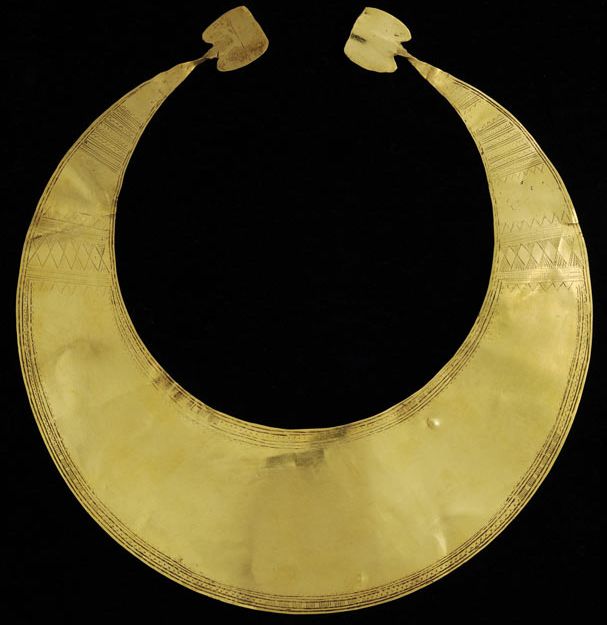
Coggalbeg Hoard
Coggalbeg Hoard
Many of you may have read the story of a gold Early Bronze Age collar which was found in a skip after the robbery of a Co. Roscomon pharmacy.
Apparently when Sheehans pharmacy in  Strokestown Co. Roscommon was robbed the burglars  turned out the contents of the safe into a skip after taking the money and valuables of interest to them. What they didn’t realise was that buried in the papers was a priceless gold torc.
Following the robbery the Sheehan family told gardaĆ­ that the safe contained three items of gold jewellery. The detectives established that the papers from the safe had been dumped in a skip nearby. Because of the flat, thin nature of these gold pieces (weighing only 78 grams in total) they went unnoticed by the robbers. After trawling through the skip the gardaĆ­ found the crescent shaped collar and two small gold discs.
Gold Lunulae
Gold Lunulae
It transpires that these items had been kept in the Sheehan’s safe since 1947.  The hoard was originally found by Hubert Lannon when he was cutting turf in his bog at Coggalbeg, Co. Roscommon. It was discovered when investigating the provenance of the hoard that Mr Lannon had died at age 93  just three weeks before the robbery in March 2009. His family were able to confirm that he had found the gold in his bog and had given it to Mr Sheehan the Strokestown chemist.
Once the gold had been recovered it was sent to the National Museum of Ireland to be cataloged and dated. This hoard is extremely important as it contains the first pair of discs to be found since the nineteenth century.  The find is also important as it represents the first recorded association of a lunula and gold discs. This is very significant for archaeologists as they study the period in which collars and discs would be worn.
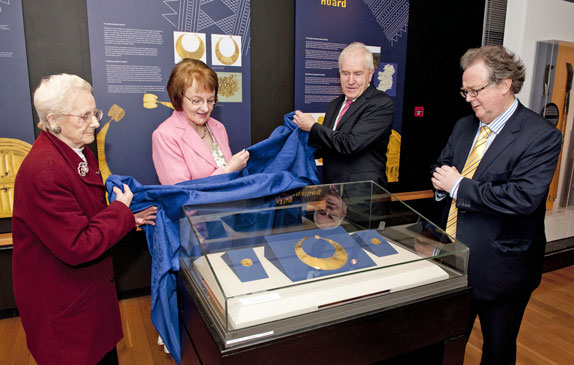
Last week the Coggalbeg hoard went on display in the Museum of Country Life in Turlough Park, Castlebar. This amazing find will remain there for all to see until June 2012.
What a strange set of circumstances resulted in this hoard finding  its way into public view. How many other treasures are buried in safes and under beds around the country?!

Four Funerals and a Wedding


 Every morning I check this very useful website http://www.rip.ie/ 
It gives a short account of any deaths published in the day's newspapers. In the 19th century people  had to wait for the weekly paper to see who of their neighbours was no longer with them. The following are a few obituaries Ger unearthed in The Kerry Sentinel.

  May 16, 1855 
at Bally-M'Elligott, county Kerry, Christopher CRONSBERRY, aged 102 years, and on the same day his wife, aged 105 years. They were married eighty years.

1830 
A man named Daniel CRONIN, a carpenter, whilst at work in Kilarney, on Saturday, and after joyously smoking a pipe with his fellow labourers, fell dead.


1779
Yesterday was married, Michael DEE, butler to the Rev. Dr. MAUNSELL, aged twenty-two to the agreeable Widow CUSACK, aged seventy-five.

1832 
Suddenly, in Killarney, on Sunday the 4th instant, at the patriachal age of 90 years, Thomas HILLGROVE, Esq., formerly of City of Cork, and one of the oldest freemen of that City, but a resident of Killarney for upwards of half a century. In the year 1798, although theretofore indulging in a more than ordinary share of exercise daily in the open air, he resolved to sequester himself from "the busy haunts of men," dreading the consequences that might result from the rebellion of that year, although Killarney then enjoyed perfect tranquility, but which he considered only as a "deceitful calm," and so religiously did he adhere to his strange resolve, that since but twice has he oe'rstepped his threshold. He enjoyed an almost uninterrupted course of good health ever since, and up to the period of his dissolution, had all his faculties unimpaired.

Don't forget tonight in The Harp and Lion  for NKRO's Trad. Night
and 
next Tuesday in The SeanchaĆ­ for our NKRO meeting at 7.30 p.m.

Thursday, 3 November 2011

Are you typically Irish? Exciting new county by county project


ARE YOU TYPICALLY Irish? A new project has been unveiled by the Genealogical Society of Ireland and the Royal College of Surgeons in Ireland, who are working together to find out more about the Irish population.
The two have launched an all-Ireland project to create a collection of DNA samples from individuals of Irish origin, which will be used to explore human genetic variation in the Irish population.
There are two strands to the project – one on genealogy and one on genetics.
Director of Archival Services, SĆ©amus O’Reilly FGSI will coordinate the collection of genalogical data, while Dr Gianpiero Cavalleri of the RCSI will direct all the scientific aspects.
Dr Cavalleri, a senior scientist of the Royal College of Surgeons, has worked as scientific consultant on the TV programmes The Blood of the Irish and The Blood of the Travellers.
The joint project will compile an Irish DNA Atlas through the  collection of birth briefs and DNA samples “to investigate the diversity of the Irish genome”, which the organisations describe as “a valuable, yet largely unexplored, resource of the Irish nation”.
They say this project “will provide valuable information on the migration and settlement patterns across the island of Ireland which will assist historians and archaeologists”.
It could also identify genetic risk factors for disease which in turn could improve future medical treatments.
The project aims to recruit individuals representing each of the 32 counties of Ireland, who will be given a saliva collection kit, a brief questionnaire as well as a chart on their pedigree.
All of their eight great-grandparents should come from the same general area so that their DNA represents that particular region of Ireland.
Participants, who are not paid for taking part, will not receive any results from the study – unless something is uncovered that might be of importance to their health.
To find out more, you are invited to email Irish.DNA@familyhistory.ie

This concludes the catalogue of Lyre woes for the moment


In 1881 the following evicted tenants applied to the Listowel Board of Guardians for outdoor relief – Michael Nolan, Denis Scanlon, Timothy O’Donoghue, Patrick Quill, Michael Ahern, John Ahern, Mrs. J Dillane, Michael Dillane, Michael Ahern Snr., Pat Sullivan. Each family was given 2s 3d a week per head. When Pat Quill, Glashnanoon, was called before the Board he stated that he was evicted not because he refused to pay his rent but because he refused to pay a rise of rent. On being evicted he had sold his stock. Fr. Scanlon who was present enquired if he had given any money to Ms. Thompson. He replied, “Indeed I did not” and Fr. Scanlon declared he was perfectly right.


Garrett Fitzgerald paid Lady Locke £10 12s 6d. The Government Valuation was £20 10s. John Hurly had increased the rent to £43 and Ms. Thompson made a demand for an extra £6 per annum. 

At that time the Duagh Ladies Land League group which consisted of one hundred members contacted the central executive in Dublin through Miss Anna Parnell – sister of Charles Stuart Parnell. They were requesting help to build a house for Mrs. Dillane who had been evicted. Mr. Fitzell, treasurer of the men’s League gave a site adjacent to the house from which Mrs. Dillane had been evicted. A sum of money was sent to the group. The Ladies League enlisted the help of the Men’s League to build the house.
On Thursday 12th May 1881 at 10 o’clock in the morning twelve hundred people and about 200 horses and carts arrived on the site. In that vast assemblage there were masons, carpenters, thatchers and many of them had brought along stones, mortar, scraws, rushes and reeds.

As the building was being erected the Ladies League arrived on site carrying green banners with suitable inscriptions to the deafening cheers of the assembled workers. At five o’clock the house was built, roofed and thatched. Rev. B. Scanlon arrived with the Abbeyfeale Brass Band they received a most enthusiastic reception. They entered the house and played ‘Home sweet Home’. Fr. Scanlon congratulated the League on their bravery and determination and he said that “the house would be a monument to the principals of the Irish Land League”.
 

At a Land League meeting in Duagh the branch unanimously decided that any person grazing evicted farms would be considered grass-grabbers and would be expelled from the League. There were many grass-grabbers in the locality. In fact families and neighbours were often split because of grass grabbing. It was known to happen that one brother would take advantage of another brother’s misfortune by taking the land from which the former had been evicted. 


Boycotting was a defence mechanism encouraged by the Land League. The first farmer in the neighbourhood to be subjected to the system of boycotting was in Gortaclahane in 1880.
Farmers who took evicted farms were unable to procure servant boys. It was also impossible for them to sell their butter and milk on market day. A Bellman would caution intending buyers not to have anything to do with the grabber or his goods. 


In 1887 Brigid Joy, Knockalougha, the mother of seven children, with a half-acre of land was in receipt of outdoor relief when a neighbouring farmer objected to her getting the relief. He believed she was not in want of it as she had children working. Mrs. Joy denied she had anyone earning but she had to hand over her half-acre to the objecting farmer.


On a Friday morning in January 1887 three bailiffs from Tralee under the protection of about thirty policemen called to the farm of Mrs. Lyons, a widow of Knockalougha. They seized nine head of cattle and a horse in lieu of rent due to her Landlord Major Leahy Nash of Tralee, which amounted to £45. On driving the stock to the pound, the horse was tied by halter to the last car in the procession, upon which sat four policemen. The cattle were driven in front of the other cars by the bailiffs. A large crowd of people had gathered along the way. When they were within two miles of town a man in the crowd cut the halter by which the horse was tied to the car. Another athletic young man mounted the horse and galloped off toward Knocklougha, amidst the shouts and cheers of the crowd and to the utter astonishment of the policemen. The man who cut the halter was immediately arrested while two cars of police went in pursuit of the man on horseback. They failed to get horse or man. Mrs. Lyons holding consisted of fifty acres. She agreed a settlement with her landlord to purchase her holding over seventeen years and she paid him £15 to get her cattle back. Evidently Major Leahy Nash was aware that this was the best bargain he could possibly make because of the difficulties that existed with regard to the sale of cattle seized for rackrent.


Returning to Tralee one Friday Night after visiting some evicted farms in Lyreacrompane an attempt was made on the life of Lucy Anne Thompson at O’Brennan. A wire paling was put across the road to upset the vehicle she was being driven in. The horse was badly hurt and the driver was injured but Ms. Thompson was unharmed.


THE FOLLOWING ON THE HURLY PROPERTY WERE SERVED WITH WRITS FOR POSSESSION IN APRIL 1881: 


Michael Doran, Matthew Doran, Garret Fitzgerald, Pat Quill, John Ahern, Michael Moloney, Daniel McCarthy, John McCarthy, M. Dillane, John Dillane, Michael Molyneux, John Nolan, T Donoghue, D. Murphy, James Nolan, Con Nolan, Kate Nolan, Patrick Ahern, Michael Ahern, Pat Connor, John Moloney, John Brown, Robert Brown, Daniel Moloney, Jeremiah Moloney, Robert Joy, Daniel Brown, Timothy Quill, Maurice Connor
(Thank you very much, Kay)
 If you are seeing the name of one of your ancestors among these, spare them a thought today as we pray for our dead.

Date for the diary: Tomorrow, Friday Nov 4  NKRO's next traditional night will be on in The Harp and Lion in Church St. at 9.30.  Prizes to be won!!!
Wednesday, 2 November 2011

Today in Listowel/1881 in Lyreacrompane


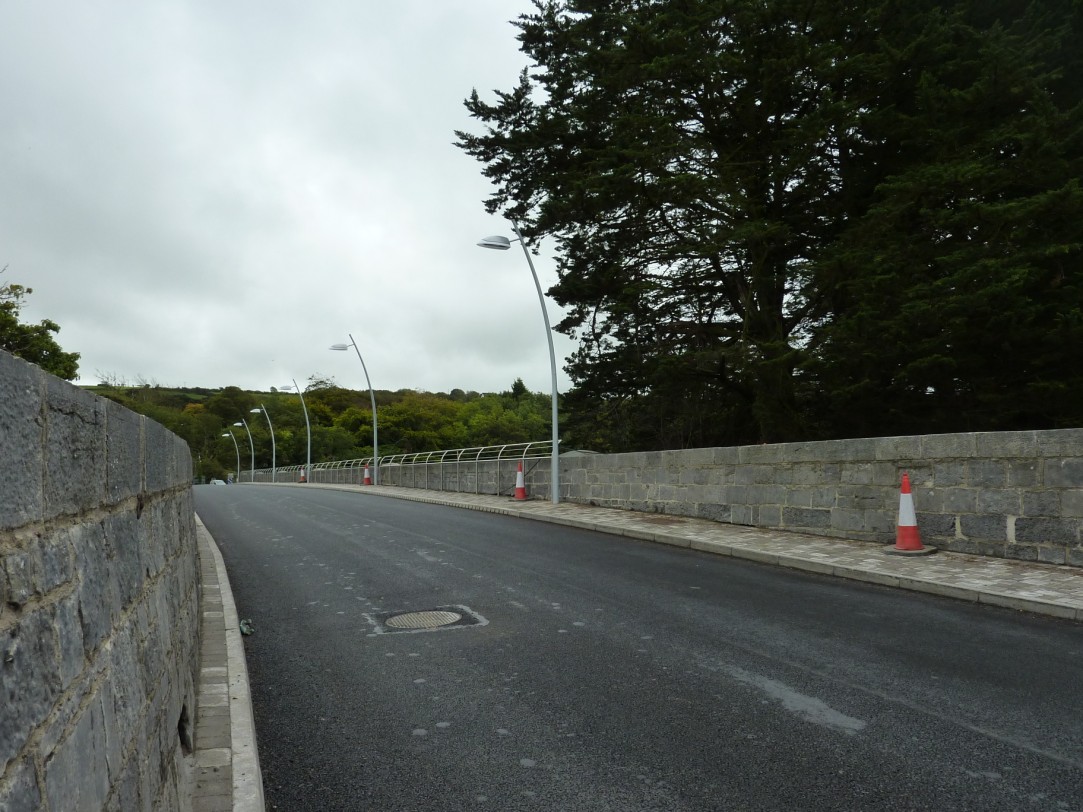
This is the Big Bridge in Listowel on the day the refurbrishment was completed. Unfortunately since then it is in the dark. Our lovely new lights do not shed any light. We are all hoping for a swift resolution to the problem.

Now back to the metaphorically dark days in Lyre in 1881 as I continue Kay O'Leary's account of more poor unfortunate tenants;

On Monday 16th. September 1881 Lucy Anne Thompson evicted Michael Moloney of Carrigcannon and his eight children from their home. At one time Michael Moloney’s farm had been a swamp situated in the centre of a long bog about two miles from the road. He had reclaimed sixty acres of it and made it into a comfortable farm, drawing on his back limestone to improve it. The government valuation on the farm was £8 5s. The rent was £23 3s and Ms. Thompson had asked him for £16 more. When he did not submit to this unjust demand, he and his children were thrown out of their home. Neighbours gave Michael Moloney and his children shelter. Michael Moloney was a widower.

Michael Moloney was unprotected by the Land Act, as he was only a caretaker since April1880. 

He had not succeeded in getting his crops off the land before been evicted but the local Land League took up his case. They appointed a day on which people of the surrounding district would get the opportunity to demonstrate their adherence to the principles of the League, by coming out to take Moloney’s crops from the farm.
From 10am two thousand men and women came bringing with them reaping hooks and heavy farm carts. After four hours work all the crops on the farm including 3 acres of oats, 1 acre of rye, 2 acres of potatoes, 2 acres of rushes and 20 ton of hay had been taken from the evicted farm and stored at his brother’s. Refreshments consisting of six half barrels of Guinness Stout with plenty bread and butter were provided. In the morning when the people began to assemble at Moloney’s farm the bailiff who had been staying in the house guarded by six policemen left for Listowel with four R.I.C. officers.


John Ahern and Mrs. Michael Ahern held a joint farm and Pat Ahern and Michael Ahern held a lease to a joint farm since March 1859. The four families were evicted. Under Lady Locke they paid a yearly rent of £13 10s the Government Valuation was £16. Under John Hurly the rent was increased to £38 and Ms. Thompson had demanded a further £10.
Having been evicted the families were allowed in as caretakers. Mary Ahern and her eight children were receiving 15s a week from Mr. O’Sullivan, Relieving Officer. A report was made to the Listowel Board of Guardians, by a neighbour, that she had cattle grazing. This was found to be untrue and her weekly relief was continued.


Tuesday, 1 November 2011

More on evictions in Lyreacrompane

Today I am continuing Kay O'Leary's heart rending stories of evictions in the 19th century.


In 1881 the agent for the Lyreacrompane landlord, John Hurly, was Lucy Anne Thompson. She was not satisfied with the rents the tenants were paying and she decided to increase them.
When the tenants refused to pay the increase they were ruthlessly thrown on the roadside and depended on their neighbours for shelter and support.

At a Land League meeting held in Duagh in 1881, Rev. B. Scanlon, President, informed the gathering that the bulk of tenantry on most of the properties in the parish were under ejectment or had proceedings against them for the recovery of rent. Rev. Scanlon also stated that “in every portion of the County where Ms. Thompson holds sway the unfortunate tenants were in the same sad conditions as they are in Lyre”. Fr. Scanlon was the National Convention delegate for the Duagh Land League. 


Some testimonies from the time are clear evidence of the difficulties tenants had in dealing with their landlords.
In March 1881 Julia Nolan wanted to assign her holding and cattle to her son John on the occasion of his marriage. The landlord objected. After the passing of the Land Law Ireland Act in 1881, she applied to have a fair rent fixed. The Landlord resisted the application on the ground that she had parted with possession. In February 1884 she executed a formal deed of assignment to her son John. He then applied to have a fair rent fixed. The Landlord again resisted.


In April 1881 Mr. W. Hartnett, sub-sheriff, accompanied by a force of police evicted Mary Gallivan, Knockanbrack. Mr. George Sandes was her Landlord. Mrs. Gallivan, a widow had gone to Mr. Sandes to get him to acknowledge her son, Michael, as the tenant of the farm. Mr. Sandes would not acknowledge a change of tenancy unless Michael Gallivan paid £200 and agree to an increase of £10 a year on the rent. The Gallivans were unable to meet the demand and Mr. Sandes had them evicted.
Denis Scanlon was a tenant on the Hurly Estate, which was been managed by Lucy Anne Thompson. In 1858 Denis Scanlon held his farm under Lady Locke before John Hurly purchased it at a yearly rent of £8. 5s. The Government valuation was £8 10s. Following the purchase of the estate by John Hurly, Denis Scanlon’s rent had been increased to £20 and Ms. Thompson was demanding a further increase of £5 per annum.


In June 1881 a large contingent of police, regiments of soldiers, cavalry, infantry, ambulance wagons etc. arrived in Listowel. This formidable army marched from Listowel to Carrigcannon (Lyreacrompane) putting terror into the inhabitants of the district, between. They soon arrived at Denis Scanlon’s house. They immediately asked him to abandon the home of his birth. This he refused and at once the law went into action. The bailiffs threw large stones against the door and eventually gained entry followed by the sheriff. Scanlon was dragged from his home, the home where his grandfather was born. His wife and six children were also thrown out of their home. A neighbour immediately gave them shelter.


More on this tomorrow