Tuesday, 17 February 2015

KBN, Lartigue 1910 and the lavoir

Kerry Business Women's Network Expo 2015


This is Jean Quille. On Sunday Feb. 8 2015 she was in Fels Point Hotel helping to run the very impressive KBN Expo.


I ran into Niamh  Buckley of Duagh who had just met up with some fairies from Killflynn Enchanted Fairy Festival


Tha Crafty Bookworm was there with a lovely display of children's books. Mishael Healy Rae was taking an interest.


Could Michael be about to change career path?


Karen of Craftshop na Méar and Swinky Doo had a beautiful array of her crafts on display.

<<<<<<<

The March of Time


<<<<<<<

A French Lartigue


While I was the south of France I visited a factory and shop called Lartigue 1910, which is located just outside Ciboure. Apparently Lartigue is a common name in this area. 

This factory is in its 4th generation of linen manufacturing. Espadrilles are typical Basque summer footwear. Lartigue 1910 was making these in Ciboure since before WW2. After the war a textile family in the north of France was getting out of textiles and into aeronautics. The Lartigue family bought two of their German built machines and brought them to Ciboure. With these new machines they expanded their lines into house linens. Today their products are all made on site in Ciboure and sold exclusively in the factory shop or on line


The lady who gave us the factory tour had never been to Ireland nor had she ever heard of the Lartigue who designed the monorail..

<<<<<<

Washer women


This is a lavoir. You will see these still preserved in lots of French towns. They were outdoor washeterias where the local women would congregate to do the family washing.

Carine, my French daughter-in-law, remembers going to one of these places with her grandmother. By then these locations were no longer used for washing but the custom of women gathering there to swap gossip continued long after houses had their own washing machine.

By the way, I remember a washer woman coming to our house every year for a few days in early summer to wash the blankets. She and my mother spent 2 days washing, by hand, all the blankets from all the beds. 
Thank God for duvets.

Monday, 16 February 2015

Rathea Listowel and San Sebastian

Listowel's changing face


<<<<<<<<<

Do you remember this?
         
                          
Built in 2000, destroyed by a storm in 2014


<<<<<<

The following article was published in the Rathea Irremore journal a few years ago

                                                                                         
 Yarns from Rathea

Dan Lyons of Rathea was better known as The Major, possibly to distinguish him from his near neighbour, Anthony Dan Lyons, sometimes referred to as Spec, who was a great poet with many compositions to his credit. I would hope that poems by the latter may be resurrected and be printed in this or some other local journal, thereby getting a new lease of life.

However, it is with a few yarns concerning the Major, I'm now going to deal with. He had a tidy farm of good land. He kept about eleven cows, no bull. I suppose he would only keep ten cows if he had kept a bull. When a cow would come around, he would rope her and take her about a half a mile down the road to the Yankee Kirby's.

However, after many years and he was getting older and possibly getting tired of jostling with recalcitrant bovines along the road down to Kirby's bull, he surprised everybody by setting off for Listowel Fair one morning. There he duly purchased the worst, smallest and cheapest bull in the fair. It would seem that economy in financial matters was one of his strong points.

Arriving home with the bull in tow, he walked proudly into the yard. His wife came out to view the purchase. It seems she got a bit of a shock when she laid eyes on the acquisition. However, she, it seems rallied quickly, and proceeded to berate and scold The Major with considerable volume and at great length, for buying such an article. "Sure the calves off him will be no size,” she finished, breathless. Seizing his opportunity the Major spoke out in his own defence. "What do you talk about woman?" he said, "no calves off him because he is small, Paddy so-and-so is only four feet ten, and hasn't he two sons in the guards."

The Major and his wife reared a large family. They were very brainy. One of them, Simon by name, joined the Franciscan Order, was ordained and in due course attained considerable status in same. He was the author of several books on religious subjects.

The Major was very fond of playing cards. Cahill’s was the house for the game. Either he was a bad player, or unlucky, or both, for he seldom won a game and arrived back home without a copper in his pocket. Now when Simon, whose name in religion was Father Adrian, would come back yearly on holidays, he would accompany his father to the card game, and being a good player, or lucky, or both, he'd finish the night in possession of a heap of coppers. Being a Franciscan, and forbidden by the Rule of his Order to keep money, he'd hand it over to The Major. The latter would pocket the money with a self satisfied smile, turn to Fr. Adrian and say: "Simon you’re the first one of your cloth that wasn't a robber".
            
                        John Joe Sheehy.


<<<<<<<<

More from my continental holiday


My January holiday in the Basque country taught me lots of things about the Basque people. They have one of the oldest languages in the world. It bears very little or no similarity to any other language. The above tableware is decorated with the local Basque symbol.

There are 7 Basque provinces straddling the Pyranees between Spain and France. Navarre is the biggest.  Basque people are fiercely proud of their language and traditions. I'll tell you more about that anon. Today I want to tell you about my trip to Spain.

Ciboure is very near to the Spanish border. It is the custom locally for people to take a trip across the border to San Sebastian on a Sunday afternoon. When in Rome….

We took the train from Hendaye. There was no acknowledgement of a border. We just travelled from one town to another with no feeling that we had passed from one country to another except that now the train station names were in Basque and Spanish rather than Basque and French.

San Sebastian was an eye opener!

I never in all my living life saw so many fur coats.


I am reliably informed that Spanish people live in small apartments and live most of their lives outdoors. Certainly it would seem that donning your fur coat and promenading on the front in San Sebastian on a January Sunday is the done thing for Spanish ladies of a certain age.

<<<<<<

Back home: Some Artistic window displays at Lynch's of Main St.


Friday, 13 February 2015

Home and Away; Listowel and Ciboure and post office relocation

My Holidays!

I thought you'd never ask! Nobody did so I'm going to tell you about my holidays anyway.
Zero interest! Just scroll down and there are a few then and now Listowel shop pictures to browse.


My son and his family have relocated to France for a year. They live in this house in Ciboure in the Basque country close to the Spanish border.


They live directly across the road from Villa Leihorra, a world famous art deco building which attracts much interest in summer. It was closed to visitors when I was there.


Because they live on top of a hill they have some fantastic views of the sea on one side and St. Jean de Luz, the nearby town, on the other.


Because they live on a hill, you have to climb in order to access their house.


The steepest part is their driveway.


This is the alternative pedestrian route home from town. Surprisingly, it is easier than the hill.


Ciboure is a holiday/retirement town.  65% of the population is retired. When I visited in January it was  in hibernation. Come summer the place comes alive. It is black with people. I think I prefer the winter quiet.


Apart from tourism, local people make their living from fishing. A bridge joins Ciboure to St. Jean de Luz. From the bridge I saw many many pleasure boats and a few small fishing vessels. Squid is a local delicacy.


There was a Basque festival, Bxinxo ( Basque for Vincent) in full swing.


They had the Ciboure equivalent of The Market in the town square. Killian is trying out one of the 50 ways to lose your money.

<<<<<<<


Then and Now


<<<<<

One Misty Moisty Morning ……in February 2015


Signs of Spring


Listowel Pitch and Putt Course in the fog


This new path is going in down by the river and gives access to the picnic  area.


"All the stores were closed and shuttered, all the streets were dark and bare…."


<<<<<<<

Not Long Now


Thursday, 12 February 2015

Jowika and some pictures taken from a kite


Jowika in Listowel


In Ireland in 1961 Seán Lemass was Taoiseach.  Lemass was really our first European. He encouraged trade links with Europe. With The First Programme for Economic Expansion he encouraged direct investment by European manufacturers in Ireland.
It was a case of, "If you build it, they will come."  The IDA built advance factories around Ireland and then went to the continent to persuade industrialists to locate here.
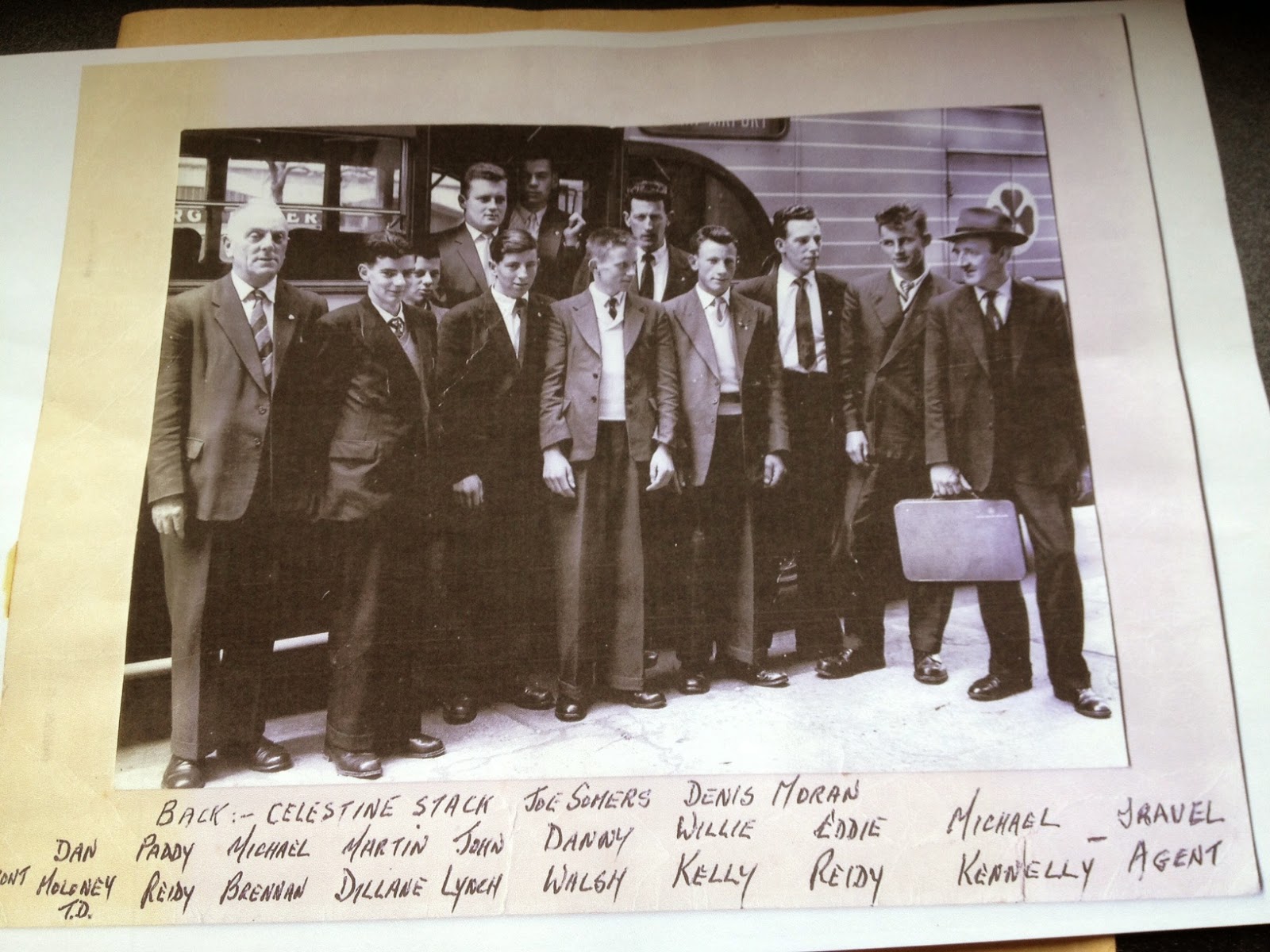
As part of this movement, Dan Moloney, T.D.  was put in contact with the Weber family who had a factory at Solingen in Germany. This factory was Jowika.
The advance factory was not yet built in 1960 when the Weber family came to town. They opened an office in a premises in Church Street; Brownes now Liam Dillons


An early employee remembers that packages were brought by horse and dray from the railway station. These packages contained cuckoo clocks and scissors. They were individually packaged in Listowel for the Irish and English market.
Another employee remembers that the kookaburra was the symbol of the company and badges with kookaburras were distributed to the employees.

The factory was finished by 1962 and there was a  grand opening.


Because they had no experience of manufacturing work and little or no German, a group of early employees were sent to Germany to the parent factory to learn the ropes.


In all about 30 local men and one woman, Cathy Halpin, went on this first learning mission. The company was very much a family business and Cathy tells me that when she went to Germany she lived with Henry Weber's grandmother in Solengen.

Jowika gave valuable employment to Listowel for many years. It was taken over in 1973 by an American knife company and traded until its closure in 2003 as Imperial Stag.

Here is a link to a video made about Jowika/ Imperial Stag, including footage from a visit by the American ambassador.

Imperial Stag, Listowel

<<<<<<<


Then and Now


<<<<<<<<

Stunning aerial photos from the kite man


Cloghane


Dingle


Blennerville