Monday, 11 September 2017

Jumpers, McKenna's, Listowel History Festival and Vincent Carmody's Race Week in the 1950s


Photo: Chris Grayson

<<<<<<<<

Painting Job well done


McKenna's is looking splendid in its new coat.


<<<<<<<

Jumpers and By Herkins

Recently I included the below snippet in a blog post

Brosna Jumpers
(from The Freeman's Journal New South Wales, Australia)

Passing to the diocese of Kerry, I observe that at a mission by the Franciscans, in the parish of Brosna, 5,000 persons communicated, 2,000 were invested with the scapular of the Blessed Virgin, and 1,200 were enrolled in the Confraternity of the Holy Family. Moreover, six unfortunate persons who had become ‘Jumpers’ made, with their families, a solemn public recantation. I may mention that this place was once the centre of a Protestant proselytising traffic, I doubt if there is any single Protestant there now.
Has anyone any idea what Jumpers were?

Joe Harrington answered my call. Here is the explanation from the Clifden heritage organisation:


The Famine years were particularly harsh all over the west of Ireland, and especially in the Connemara region whose population of tenant farmers and labourers depended almost entirely on the lumper potato. Thousands died when the potato crop failed in the summer of 1845 and failed again over the following three years. Those who managed to survive were weakened by years of hunger and disease and found it difficult to restart their lives as their work tools, farm implements and furniture had been sold to raise money for food. This was the environment into which the Irish Church Missions stepped when it began its proselytising work in Clifden in early 1848. Its arrival, with plentiful supplies of food and clothes, must have seemed like a godsend to the starving poor of Connemara.

The Irish Church Missions was established by Revd Alexander Dallas, the Church of England rector of Wonston in Hampshire and had been active at Castlekerke, near Oughterard since 1846. Its ambition was to convert the Roman Catholic population of Ireland to scriptural Protestantism and it was handsomely funded by the Protestant population of Great Britain. The Irish poor who attended the Irish Church Missions schools and churches of received clothes and food in addition to educational and religious services and, with the west of Ireland in the midst of a dreadful famine, it is unsurprising that the poor of Connemara eagerly flocked to the Protestant Irish Church Missions. Within a short time the mission could correct claim a very large number of converts or ‘jumpers’ as they were known. [It is thought that the term Jumpers comes from the Irish expression d’iompaigh siad – they turned.]


---------------


I also got this interesting snippet about the etymology of the exclamation "By Herkins"

It is a strange saying. I thought it was probably an incorrect rendition of some similar sounding-word, maybe ‘Hearken.’ This was much used in biblical connotations- 
​'​
Hearkenbrothers, give ear unto my words
​...'​

However, I believe that is not the case.

I was later informed that ‘By Herkins’ is, in fact correct, and this is validated in the story, "The Lady of Gallerus" by T. Crofton Croker 1798-1854. 

It echoes of wonderment:  "By Herkins, I nothing but a made man with you, and you with a King for your father."

--------------------

Finally, a ‘Jumper’ is someone who changed from R.C. to Protestant- usually as a result of hunger and proselytising. He or she ‘jumped ship!’ Or took the soup and became known as a ‘Souper.’

Dingle was noted as a Colony of Soupers/Jumpers.

Brosna also had a colony (though some were ‘economically’ inspired and did it for gain. Others did it to stay alive, which was o.k. in 1847 or thereabouts. Many we

nt back to their old faith when their bellies were full again!

Fealebridge on the Kerry-Limerick border (near the creamery on the old main road) had its small colony. There was a proselytising Minister, the Revd. ‘Ned’ Norman there, and he had a church in the middle of no-where. (It is reduced to rubble now- with some fine cut limestone).

<<<<<<<<

Going to the Creamery


This lovely old postcard was shared recently by Listowel History Festival. The History Festival is a new venture from the people behind the military festival. The time had come to move on from the military emphasis.  In future this festival will look at all aspects of history. If you have any ideas of how this new history weekend could be enhanced get in touch with them through their page. They are very anxious to get as many diverse aspects of history covered in the weekend.

Back to the postcard. Doesn't it take you back?  The donkey looks young and sprightly to me and his cart is either new or newly painted.  The saved hay in the background says that it is summer. I wonder could the history festival find a donkey and bring him into the town and tackle him to a flat cart. How many people nowadays could name the various items of donkey's tackling? Would' nt it be a education for youngsters and a trip back in time for us all to see the donkey dressed for a trip to town.

<<<<<<

It's Race Week


This window display in Lawlers of Church St. is getting us all in the spirit.

<<<<<<

Reminiscing at the beginning of another Race Week

Photos and text by  Vincent Carmody,       Sept.   2017


 The pristine straight, without a hoof mark… within a few hours the horses will come thundering up the hill, some gallant winners and many more gallant losers. The Listowel Arms and twin church  spires are in the distance.


 The three stands are ready and waiting to host the thousands who will flock to the Island for the seven days.

One of the many Tote facilities, this one built into the new building which was opened last year, it also includes a large bar and "The Old Weir" foodhall.


Some Listowel Races memories.

I went for a walk this Sunday morning, 10th September, back to our Island Racecourse, to see the course in its state of readiness for the first day of our seven day feast of racing. The memories came flooding back.

In the days of the 1950s when myself and my contemporaries were growing up, racing days consisted of three days, Tuesday, Wednesday and Thursday. We would have school on the Monday, and I remember one of the compositions always rostered for homework was one, either through Irish or English, with  a ' week of race-week theme '.

For us townies, the sense of anticipation, would have began during the previous week when a gentleman called Paul Kennelly from Woodford would move around the streets with a hay cart which contained specially large made concrete bases with a hole in the middle.  These had metal handles for lifting.  The bases were left on the edges of the various footpaths at either side of the road, at distances of about 30 yards. Alongside these were left tall poles, some painted black and white, more multicoloured, similar to the wooden poles one will see on showjumping fences. Mr Kennelly's next job was done with the help of some of his sons. They stood the poles into the concrete bases. This done, they strung coloured buntings from the top of each pole to its opposite across the street, until the streets were ablaze with the fluttering decorations.  Later when trucks were getting higher, a metal pole was attached to the tops of the poles. It was also customary at one stage to tie bunches of ivy on to the poles.  This was discontinued when somebody’s emancipated donkey, which had been tied on to one of the poles, decided to feast on the ivy. The stricken ass had to receive veterinary assistance and when possible litigation loomed  a stop was put to this form of decoration.

Strings of electric light bulbs would, I remember, have been first erected by Gene Moriarty. His family still keep up the practice to this day.

The market amusements were also a major part of the week, The Bird family operated the most popular of these, and were located in the back market, which was, in our time, until the building of the Mart, separated from the front market by a long shed which ran from the market wall down towards the river. The top end of the front market, inside both gates would have contained lines of travellers green coloured canvas topped caravans. This is why it  was known as the Tinkers Market. The lower part hosted small-time amusement operators, mostly with swinging boats and hustlers selling everything and anything. An abiding memory that still abides is the smell that emanated from the wood-fueled open fires which would be lit outside the caravans at dusk.

Also in Market Street, McKennas used have installed a small screen which fitted into the fanlight of one of their small doors. On this screen throughout the week they would play repeats of that year’s Grand National and other sporting events, more than likely, similar to Movietone News. I remember one of these was a match which featured Stanley Mathews. 

For those of us living near the railway station, Monday evening had its own attraction; the arrival of the special train coming from the Curragh. This would be full of racehorses, scheduled to run in the various races during the week. The Race Company had a stable yard with around 50 stables at the back of William Street where most of the horses would be housed and the overflow would go to various houses who had private stables in their backyards. The various trainers and stable boys would always require assistance in bringing their luggage and equine requirements to the stables, so we would become hastily employed and willing stablehands for the evening. The monies received would happily subsidise race-week pocket money which one would never have enough of.              
    

Friday, 8 September 2017

Dancehall Days Remembered and Listowel Races 2017 is upon us


Photo: Chris Grayson

<<<<<<<<

My Good Friends, Jim and Nora Sheahan


Nora Sheahan and her son Noel and family with Sarah Marince in The Seanchaí recently


Jim and Nora Sheahan in their cosy welcoming home

 On a recent visit I encouraged Jim to tell me his memories of a different era in Listowel

Jim remembers the days of the dancehalls.  Small local dancehalls were dotted around North Kerry in the 1940s and 50s. These were the main venues for entertainment until the advent of the big ballrooms and the easy availability of transport meant the people went dancing outside their local area.

There were two dancehalls in town, Walshe’s Ballroom and The Plaza. The Plaza which was built by Frankie Chute was a cinema but it held dances on big occasions like the Races.

Walshe’s Ballroom was first located upstairs in a premises in William Street. Sunday night was dance night and older people remember long queues of young people waiting for this hall to open.

When this hall had to close when the floor collapsed, Vincent Walshe moved operations to a site he owned opposite the Astor Cinema. He built a big luxurious state -of -the -art ballroom with a sprung maple floor, a mineral bar and a cloakroom.

The Las Vegas, as it was called had a mineral bar, with “catering by Diana.” The Diana in question was Diana McElligott.

The cloakroom was another luxury you didn’t have in the smaller crossroads halls. For a small fee you could leave your coat in safekeeping for the duration of the dance. You handed in your coat and the cloakroom attendant attached a ticket to the coat and you were given the corresponding ticket stub. If you had no pocket you had to keep the stub safely in your shoe until you came to collect your coat at the end of the dance.

The Las Vegas also had a resident band. Bunny Dalton was the band master. Jim Sheahan played the saxophone with this band for 5 or 6 years. Other members of the band were Jerry Scanlon, Mai Chute, who played the piano, John Moore of Mountcoal who played the saxophone and Jerry Barry  on trumpet. Tim O’Sullivan was Jim’s music teacher. For 1 shilling a lesson he taught him to play the fiddle. Tim also played the saxophone and he spotted Jim’s potential. Jim was already playing the tin whistle and the skills transferred to the saxaphone as the notes were the same. Since he neither drank nor smoked he had plenty of lung power and he took to his new instrument with enthusiasm.  At one stage the band had a vocalist, Johnny Cahill. This is the same Johnny Cahill who played Carthalawn in the first production of Sive.

This was the era of the big band and Vincent Walshe put together a band to rival the best in the land. Bunny Dalton and his band played for the dancing on Wednesday and Sunday nights. Occasionally, Vincent Walshe brought big names like Mick Delahunty and Brendan Boyer to town. These were known as “all night dances’ and they went on until 3.00 a.m. The big band would take a half hour break from 12.00 to 12.30 and the house band would play during this half hour.

People came from far and near to the dances. Many of them came on foot or by bicycle. If patrons were lucky enough to have a car there was ample parking in the vicinity of the hall.

There were no dances during Lent and local drama groups like Danny O’Donoghue of Lixnaw used to put on plays in the hall.

Jim remembers earning 30 shillings a night as a musician. This was good money in those days.

Occasionally the band would play in other local halls. The Walshe’s had a van for carrying the instruments. Most halls had a piano and if they didn’t Mai Fitz had her own piano accordion, which she brought with her.


Jim remembers great meals after dances in Hennesseys in Ballyduff and Doyle’s in Ballyheigue or in Hegartys. Dancehalls in those days were often built adjacent to the owner’s house.

This were the days!


<<<<<<<


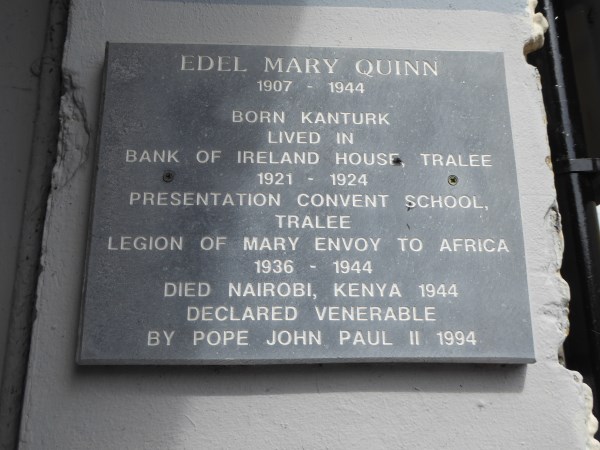
Edel Quinn and Tralee


I come from Kanturk which is the hometown of Edel Quinn. Only last week I spotted this plaque on a wall in Tralee. I learned that she lived and went to school in Tralee.

<<<<<<<<

The Longed For Week has arrived


Very soon the gate will open and the bridge will be thronged with people. Races 2017 is on our doorstep.

Thursday, 7 September 2017

From Tanavalla to Pittsburg, O'Connell's Avenue and Gapo's


Photo: Chris Grayson

<<<<<<<<

Down Memory Lane in The Seanchaí

Jimmy Deenihan gathered some old Tanavalla neighbours, a few cousins and assorted GAA friends to meet and greet Mary Kay Marince, daughter of Tom O'Donoghue of Tanavalla and Pittsburg. Tom was a great GAA supporter and a friend to any Irishman who found himself in Pittsburg and called into The Blarney Stone. Mary Kay was in Kerry with her two daughters for the Rose of Tralee Festival 2017.


Old friends, Peggy Brick, Junior Griffin and Kathleen McCarthy.


Mary Kay remembers her father and his love of Kerry in general and Listowel in particular.


Junior regales the Florida Rose with tales of her card playing grandmother.

Elizabeth meets the next generation of old neighbours, the Sheahan family of Listowel.


Elizabeth Marince with James Sheahan.


Elizabeth with Nora Sheahan, who lived beside the O'Donoghue's in Coolnaleen and who visited them in Pittsburg.


Elizabeth's Rose escort was a Donegal man. He came to Listowel to be part of her homecoming.


Elizabeth with her cousin Mossy Molyneaux.


Lots of Cousins and friends
<<<<<<<

O'Connell's Avenue 1961  or '62

Noel Roche shared this one a while ago.


Included in the photo are:
Noleen Reidy, David Roche, Giggs Nolan, Pat Galvin. Seamus Fealey, Timmy Nolan, Sheila O'Connor, Jeremiah O'Connor, Mikey Hayes, Paddy Gunn, Anita Gunn. 

<<<<<<

Gapo's of William Street


This restaurant has been doing business in Listowel for a while now. 
Recently it was featured in Listowel Food Fair's Facebook page and here is what they wrote.


"From one of the world’s most ancient nations, to a North Kerry town at the heart of rural Ireland. The journey for Gapo’s begins far away in Armenia where Head Chef Artur Gabrielyan comes from. Born and raised near the country’s capital Yerevan one of Europe’s most exuberant and endearing cities, Artur was born into a family steeped in food culture. All family both immediate and extended were involved in cooking, his grandmother Nvart was the head village Cook, the lady who villagers called on whenever there was a cause for celebration; birthdays, christenings or weddings. Nvart would gather her crew, usually several other village women all great cooks they would get together and feed the party. Creating hearty feasts of their country, sharing dishes and great times. Having grown up in this environment, it’s not surprising that Artur chose a career in food, although it didn’t begin that way. 

Living in Yerevan in the late 1990s, Artur closed the business he was running largely due to the unrest around him, the city had remained in turmoil since its break from the Soviet Union in 1991. He felt a life away from his homeland was the best option for his future. Initially planning on heading to Sweden with his friend, this didn’t work out and he found himself in Ireland. His first experience of Irish culture was watching Riverdance while still living Yerevan, the iconic dance performance captured his imagination and planted Ireland in his conscious. 
On arriving in Ireland, he first came to Dublin and shortly afterwards arrived to Listowel. It was here he found his feet and began taking English classes that were being offered at the time to residents in the town looking to learn the language. While doing these classes, a local woman Sue McKenna who noted his talent for food, introduced him to Mario Del Alessandro who took him on as a chef. And so, began a 16-year career at Casa Mia’s Ristorante further up William Street. 
Not only did he find a job, he also met his wife Liene Druka who worked as a waitress at the restaurant. Liene had arrived on a gap year from college with her friend, a native of Tukums Latvia, she spent a year at Casa Mia’s before returning to college to complete her studies. Once her studies finished, she was back in Listowel and remained working at Casa Mia’s until the birth of their first son in 2007. Following on from that she worked locally in both Ballybunion and Listowel until 2016 when the couple decided to open their own restaurant. Spotting a demand for something different in the town, while also having the opportunity to create Armenian style dishes, Artur and Liene took over the property on William Street formerly known as Mai Fitz’s. Opening on May 11th, 2016 they have made their mark as giving a unique dining experience in the town. While there are several Lebanese style restaurants located on the east coast, close to Dublin, to find an Armenia exclusive restaurant is tough. So, it may be possible that Listowel has the only Armenian Restaurant in Ireland! 
The creations at Gapo’s are uniquely Armenian with a reference to European cuisine. Artur and Liene offer an experience for their guests by taking them on a journey through the different countries by using food as their vehicle. The main characteristics of Armenia Cuisine are a reliance on the quality of the ingredients, the use of wheat in a variety of forms, of legumes, nuts, and fruit as a main ingredient as well as to sour food, and the stuffing of a wide variety of leaves. The Tabule dish for just €6 served as a starter on the evening menu is a great way of trying out the cuisine. 
And what does the name Gapo’s represent? Gapo is the name of Artur’s grandfather who without doubt would be very proud of the success his grandson has achieved here in Ireland. 
We have had a real adventure this week with Gapo’s and would like to thank Artur, Liene and their two beautiful sons Gabriel and Mikael for having us and sharing their Food Story."

<<<<<<<

A Killarney Celtic Cross


This magnificent Celtic Cross is situated in the town centre opposite The Haha in Killarney.


Wednesday, 6 September 2017

Celtic Crosses and Racecourse Tipsters and Our Little Water problem


Photo; Chris Grayson

<<<<<<<<

The Celtic Cross


The Celtic cross is a form of Christian cross featuring a nimbus or ring that emerged in Ireland and Britain in the Early Middle Ages. A type of ringed cross, it became widespread through its use in the stone high crosses erected across the islands, especially in regions evangelized by Irish missionaries, from the 9th through the 12th centuries.
A staple of Insular art, the Celtic cross is essentially a Latin cross with a nimbus surrounding the intersection of the arms and stem. Scholars have debated its exact origins, but it is related to earlier crosses featuring rings. The form gained new popularity during the Celtic Revival of the 19th century; the name "Celtic cross" is a convention dating from that time. The shape, usually decorated with interlace and other motifs from Insular art, became popular for funerary monuments and other uses, and has remained so, spreading well beyond Ireland.  (Wikipedia)


Some of the many celtic crosses in St. Michael's Graveyard, Listowel


<<<<<<<

The old Presentation Primary School is demolished


Photo by Denis Carroll: July 19 1991

<<<<<<<

Racecourse Tipsters  by John B. Keane

(continued from yesterday)


Racecourse tipping calls for little or no skill. A peaked cap and a well-worn raincoat is the usual attire and while a pinched face is an asset, it is not an absolute necessity. An air of confidentiality also helps. The first practicing tipster I knew managed to give the impression that he singled out only certain people for his favours. Before making a sale, he would first look about to make sure that nobody would know what was happening., thereby convincing the customer that if too many people knew the identity of the horse the odds would not be worthwhile. He might also hint that he was a dropout from a racing stable and was possessed, as a result, of inside information. Throwaways like, “He was nobbled last time out,” or “He likes it yielding,” or “He’s off today,” never fail to impress prospective customers.
Now let us look at the trade’s accouterments. These are simple and few, I am happy to report. First, one must be able to read and write. Secondly, a large stock of notepaper and envelopes is essential.
Now let us suppose that there are nine horses in the first race. Let the tipster write the name of each horse on a single sheet of notepaper and indicate whether it should be backed for win, place or each way. Obviously hot favourites should be backed only for a win. Outsiders should, of course be backed for places or each way. Place each sheet of notepaper in its own envelope and seal the envelope. Place the nine sealed envelopes in a larger envelope and indicate clearly that it contains the entrants for the first race. Follow the same procedure for the remaining races. Tips should be sold for roughly a pound apiece.
When all are not sold, the unsold envelopes should be given away for nothing as it is absolutely vital that all the envelopes be distributed. This guarantees a winner and three placed horses in every race, which has sufficient runners for place betting. Let us presume there is place betting on six races on the card. This means that you will have tipped six winners and twelve placed horses. It also means that there will be a substantial number of satisfied customers.
During the races the tipster might repair to a bar and partake of a few bottles of stout and a ham sandwich. He should always vacate the bar before the last race and place himself in a conspicuous position near the main exit. There are certain risks involved. A punter who may have plumped on a loser recommended by the tipster may well seek physical redress. There is also bound to be heaps of abuse as naturally he will have tipped far more losers than winners but these are hazards of the trade and who wants a trade without hazards.
On the credit side, there is also a good chance that those who have backed winners will not be unmindful of the man who provided them. Those who back winners celebrate as a rule with intoxicating liquor and it is widely held that intoxication breeds generosity.

Racecourse tipping is open to both sexes. In fact it is a calling at which a presentable female might excel more than her male counterpart.

<<<<<<

New 2 You


This new second hand shop has opened for business in Market Street. They have everything  from large items of furniture to children's toys. They have an association with Neurofibromatosis Ireland.

<<<<<<<<<

Water Crisis brings out the Best in us

On Sunday last Sept 3 2017, we had a small water crisis when a pump broke down at the Listowel reservoir. Irish Water and the County Council were on it like a shot. The disruption to supply was kept to a minimum and by Monday we had tons of free bottled water available as well as the water from the tanks that had arrived on Sunday. Everyone helped vulnerable neighbours and hospitals and schools were kept supplied.


Listowel Town Square Monday September 4 2017


In the carpark opposite Listowel District Council offices

<<<<<<

Just a Thought

Last week I had the task of delivering you a thought for the day on Radio Kerry.
In case you missed me and would like to listen while the thoughts are still available online, here is the link

Just a Thought by Mary Cogan