Showing posts with label Gerard Mulvihill. Show all posts

Friday, 21 September 2018

Library Rd., Jerry Hannon and Some photos from Listowel Races on Friday


I snapped these ripening conkers on the horse chestnut tree at the entrance to Gaelscoil Lios Tuathail.

<<<<<<<<

Race Week in Listowel, Early Evening


Live Music in Market Street

<<<<<<<

Jerry Hannon,  Voice of Irish Racing


Jerry posed for me with his great friend, Marietta Doran


Here is a  article by Colm O'Connor about Jerry from last weeks' Irish Examiner.

Almost 20 years after beginning his career at a pony meeting in Athea, Jerry Hannon became Ireland’s primary racecourse commentator in July following the retirement of his ‘inspiration’, Dessie Scahill.
Q: How did it all start?
A: “The seed was planted in my hometown of Listowel. It seemed that all of North Kerry would grind to a halt for the annual festival every September. People who might never step inside a racecourse from one year to the next would be there. 
My first memory of the races down at ‘the island’ was when I was about seven or eight. I had a black and red BMX that I would park up at the finishing post — but then I would turn my back on the racing itself.
Instead of watching the horses, I would watch Dessie Scahill who was the course’s racing commentator. He was my inspiration. I was just in awe of him and what he was doing. 
I’m not from a big racing family but my late dad, Joe, would have been into it and I would travel with him to race meetings like Killarney and Galway as a child. The more I went, the more interested I became.
People might remember that Sports Stadium used to have racing highlights back then. I would sit in front of the TV on Saturday afternoons and record the commentary sections on cassette and play them back over and over again. When I got older I had this impression I would do of Micheal Ó Hehir’s famous commentary of Foinavon’s win in the 1967 Grand National. 
The Racing Post had a transcript of what he had said that day and I learned it off by heart. I used to do it for friends and family but I’d be so shy that I would only do it if I was behind a door or under a table. Liz Horgan, who was from Listowel, heard it and was really impressed.  Her dad, James, was hugely involved in the pony circuit at the time and she twisted his arm to let me commentate on some races one day. 
And so I did on October 17, 1999, in Athea in Limerick. I can remember the day clearly — Chris Hayes, Nina Carbery, Billy Lee, and Davy Condon were all there that afternoon, starting out, just like me.
And look where we all are 19 years later.
Q: But you were more than just a commentator?
A: My dad was very good friends with Liam Healy, the legendary racing photographer from Listowel. I used to go up to his office as a child and soon started to help out, numbering and indexing the pictures. From there I progressed to being his bagman at race meetings throughout my teenage years. Then he gave me a camera — he always said I had a great eye for a photo! Would you believe that I had visited every Irish racetrack by the time I was 17 in my work with Healy Racing. So when I finished secondary school at St Michael’s College I went straight to work with him on a full-time basis. He had a huge influence on my career and I’m eternally grateful to him for the support and advice that he gave me. So when I started doing more and more commentaries at the point-to-points, I’d often be double jobbing. I’d call a race and then sprint down to take pictures of the winning connections in the parade ring afterward.
Q: Your progress was remarkably quick?
A: It was. A few months after that pony debut in Athea I started out working at point-to-points which was a very big career step. But the connection with the Healys was perhaps a help as I wasn’t a complete unknown around the circuit (in fact my first racecourse access card read Jerry Healy, not Jerry Hannon). I started off doing point to points in Askeaton and Bruff in Limerick and it took off from there.
Q: And then came a slice of luck?
A: I was up in Downpatrick in May 2000 taking pictures for Healys. It was a two-day meeting and on the Friday night we were out for dinner with the Polly Family and it turned out their dad’s memorial race — the Willie Polly Memorial Handicap Hurdle — was on the next day. I did one of my commentary party pieces that night and they enjoyed it so much that they asked me to do the commentary on their dad’s race the following day. The racecourse manager Iain Duff and the inhouse commentator Neville Ring happily acceded to their request and that is how I got my break into racecourse commentary. Neville stood down from the role a few months later and asked me if I would like to take over. Needless to say I’ve had a soft spot for Downpatrick ever since.
Q: So you were up and running, if you pardon the pun, but it wasn’t an overnight success?
A: It has been a hard slog to get to where I am. I grafted very hard and made a lot of sacrifices. I missed so many family occasions like weddings, communions, birthdays because of racing commitments. I also had to hold down other jobs as well because the number of racing commentaries I was doing simply wasn’t enough to keep me going alone. So I had stints working with Cadburys and Paddy Power over the past 19 years.
Q: What’s more important — talent or hard work?
A: I’d say hard work first and foremost but you still need a sprinkling of talent as a foundation.
Q: What is the secret to a good commentator?
A: The soundest piece of advice was from Pat Keane (former Irish Examiner racing correspondent). He told me to ‘keep it simple and don’t add anything that is unnecessary.’ And I’ve worked to that mantra since then. And my Dad used to tell me that I should treat every single race like a Derby or a Grand National. And those are words that I never forget. I’m a bit of a traditionalist, I’m not paid to be a comedian or have these flashy one-liners. My job is to call it like I see it. That is what I aim to do with every race I commentate on.
Q: Has technology made your life easier?
A: Yes, nowadays all the racecards are in colour so it is easier to work out the jockeys and so on. When I started out in point-to-points the cards would be in black and white so I would bring my own pencils to add the colours!
Q: Technology is a double-edged sword. Is your job more difficult in the social media age?
A: Yes. You are very exposed and quite vulnerable to keyboard warriors. It is a bit like being a jockey, you are only as good as your last performance. Nowadays your commentary is more than just at the racecourse. T
his week gone by. I was working at Listowel but that commentary was going out on At the Races, SIS, on Radio Kerry, on phonelines. It means there’s no room for complacency if you are doing a midweek meeting or the major weekend race. You have to be thick-skinned in that regard and for the most part I stay away from forums and the like. But thankfully I’ve never had any issues in terms of trainers, jockeys, or owners.
Q: Your toughest commentary?
A: A 30-runner, five furlough maiden up the Curragh. Which is all done in less than a minute. Now that is a challenge.
Q: Your favourite commentator in any sport?
A: Mícheál Ó Muircheartaigh.
Q: What does this new role mean to you?
A: I’ve been lucky in life, not everyone’s dream becomes reality. I’m 37 and landed the senior racecourse commentary role through nearly 20 years of hard work and hard graft. The Association of Irish Racecourses are my employers and they realised and rewarded me for my loyalty over the years. I have to punch in 220 racing days from July to July around Ireland. I completed the full set the week before last, with my commentary at Laytown meaning that I’ve commentated at every racecourse in Ireland. It is an honour and a privilege every day and hopefully there are more wonderful days ahead.”

<<<<<<<,

Style on Ladies Day 2018


I met Dick Carmody and his friend at the parade ring.

Stylish couple, Sharon and Antony

The Tg4 crew were looking resplendent.

Barbara and Gerard Mulvihill and friends were out in style.


Betty McGrath and her friends are always eye-catching on Ladies Day.

This fabulous sunflower creation did not win the prize for the jazziest hat. It would appear that that prize is decided among the 10 finalists in the best dressed lady competition.
I think, maybe,  they should rethink that one.

  Mother and daughter, Lorraine and Maria were beautiful.


I spotted this really well turned out groom in the parade ring and I wondered if he had been roped in to lead out the horse at short notice. Not at all. The next time I saw this man he was on the stage being presented with a prize for being the best dressed groom.  It's great to recognise the hard work of these men and women who work away behind the scenes preparing the horses for racing and hosing them down afterwards. I think next year they might all be throwing on the suit they bought for a wedding.


I recognised a famous North Cork musician among the crowd. The last time I saw Liam O'Connor he was moving the mourners to applause amid the tears at the funeral of my great old friend, Peggy Keane of Freemount. What a musician!


For people who were there as much for the fashion as for racing, there was a roving Tote service to make sure you didn't miss out.

<<<<<<<<
Culture Night
Tonight, Sept 21 2018 is Culture Night and Listowel has great things in store for us . Call in to the Seanchaí after 6 and Listowel Writers' Week will give you a present of a book. That's it...no Ts and Cs, just a book for nothing.

St. John's and the Kerry Writers' Centre have great programmes planned and at 9.00 outside St. John's we are the get a light show, a foretaste of what's in store at the upcoming Féile an tSolais. Great night in store. Don't miss it.

<<<<<<

That Photo

Denis Quille recognised Dan Lou Sweeney in the front and his son, Billy confirmed it.

Billy MacSweeney had a few more names as well;

Looking at the Doodle photograph I recognize my father Dan Lou McSweeney
seated right at the front, Tom O'Connell right behind him. Mick Carey on
Tom's right next to 'Stackianus' with Sean Grogan on the latter's right.
Dermot Tatten is front left. That could be Chuck Roche behind Mick
Carey. That's all I can make out.
<<


Monday, 30 May 2016

Blue Box Appeal, Local Author, Gerard Mulvihill, a Fleadh success in 1997 and an enquiry into Agrarian Outrage in North Kerry


Garden of Europe May 2016


<<<<<<<<


The Big Blue Box Appeal

The Blue Box Appeal is a fundraising initiative undertaken by Bank of Ireland in conjunction with The Society of Saint Vincent de Paul. On Monday last, May 23 2016 the appeal came to town. The idea is that a team of cyclists take the blue box from town to town. The cyclists are volunteers. In each town as the box lingers a while a big fundraising effort is put in. In Listowel the cyclists were met by the Convent School Band. When they reached the Square, Jimmy Hannon and his band had another show in full swing. There was a barbecue, Woody and Mickey and Minnie were in attendance and all the schools brought their pupils to enjoy a great morning. Meanwhile around the town, St. Vincent de Paul volunteers were holding a flag day.


<<<<<<


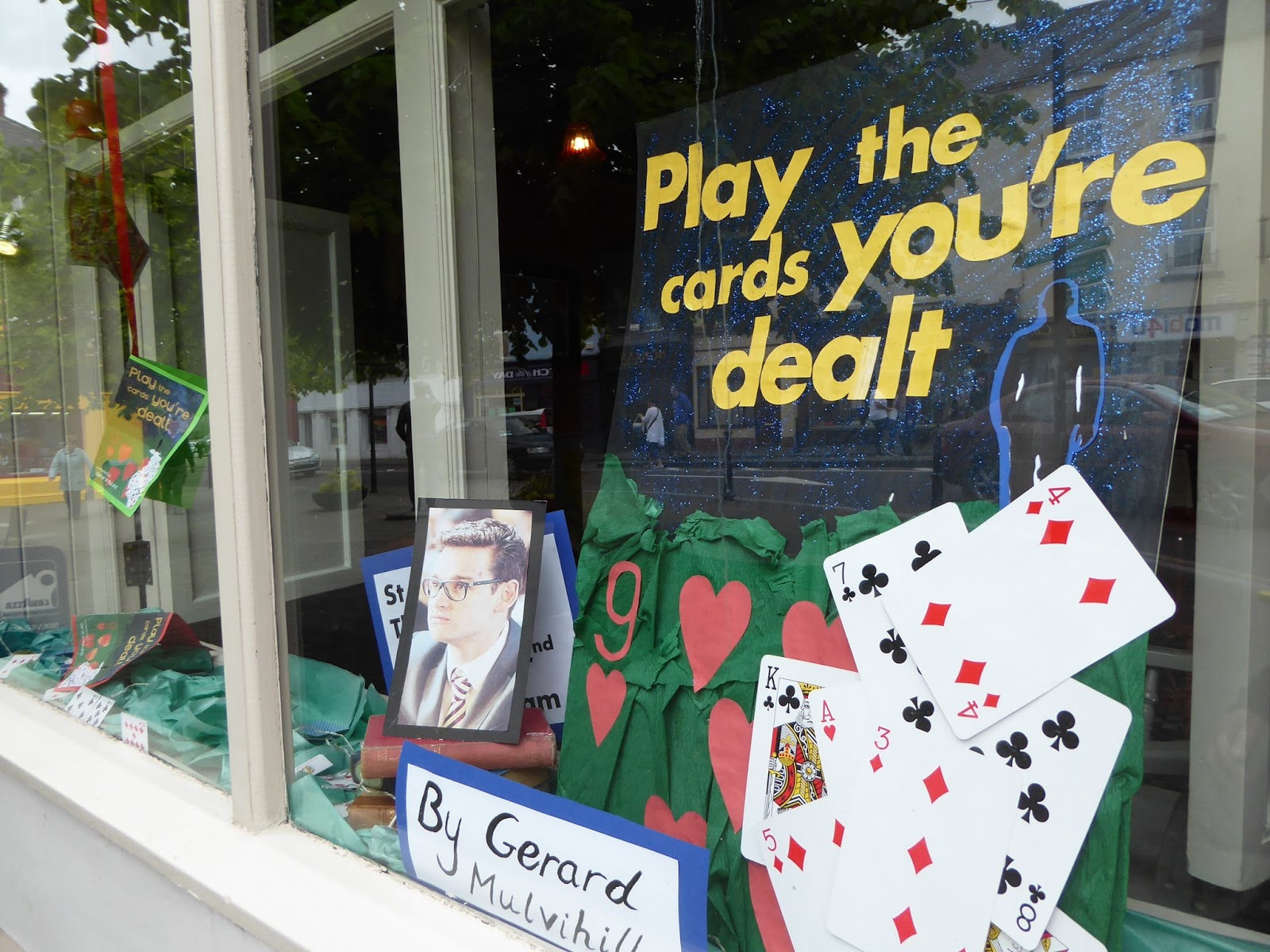
Play the Cards  You are Dealt


This book by local author, Gerard Mulvihill will be launched at Writers Week 2016

<<<<<<<


Fleadh Time Again

Hard to believe its 19 years ago. This photo was originally shared on Facebook by Elizabeth Brosnan.

<<<<<<<

The Fitzmaurice land Murder: The Parnell Commission on Crime

A friend of Listowel connection  who has read a lot about this incident  writes;

" I have read a lot on the Kerry 'outrages' and am quite taken aback at the cruelty,  viciousness and  brutality that seemed 'normal' among the moonlighters when 'dealing' with ordinary people of their own sort and station in life.  I hasten to say that this did not solely apply to Kerry-  the same can be said about  all other counties where unrestrained violence became the 'local law.'

The fear of the workhouse - and the moonlighter- made people callous and craven; but it would be almost  impossible to  blame them in the cirsumstances.
It is very easy to raise the devil- it is another thing entirely to put him back where he came from!"

The above message was accompanied by this  extract from an account of the Parnell Commission's Enquiry into the Fitzmaurice murder. Nora Fitzmaurice, the victim's daughter was with him when he was shot. She gave sworn evidence to the enquiry.


“FITZMAURICE'S OFFENCE - LEAGUE'S ACTION.

He would now call attention to the case of James Fitzmaurice, 60 years of age, whose murder was one of the most brutal character. He was killed on the 31st of January, 1880; but for two or two and a half years his life had been made a misery to him. His murder was directly traceable to the Lixnaw Branch of the Land League. It might be said that the Land League was suppressed three weeks before his murder, and, therefore, the organisation could have had nothing to do with it; but he should be able to show that it had. In 1887 Fitzmaurice helped Mr. Hussey, a landlord's agent, over a ditch. That was his offence, and the local branch of the Land League then issued the following resolution, which was given in the Kerry Weekly Reporter: - "That as James Fitzmaurice has acted the part of special constable to S.N. Hussey on the 14th inst., we consider his neighbours should hold no further intercourse with him."
That was in June, 1887. On the 31st of January, 1880, Fitzmaurice was shot while driving with his daughter in the morning. There were several persons who then passed them on the road, but they dared not go to the assistance of the dying man and his daughter. The men charged with that murder were defended by the National League funds. He (the learned counsel) supposed it was to see that they got a fair trial.


THE DISPUTE WITH THE BROTHERS FITZMAURICE.

Norah Fitzmaurice was the next witness. She is a tall good looking young woman, and gave her evidence very clearly. She stated that her father, Jas. Fitzmaurice, lived in the parish of Lixnaw, in the county Kerry, with her uncle Edmond, the two holding a farm of sixty-six acres. Both were ultimately evicted for non-payment of rent, and were put back as caretakers. Prior to the eviction, a dispute had arisen between her father and uncle, as the latter was not willing to pay his portion of the rent, and it was in consequence of this that the eviction took place. In March, 1887, her father was made tenant of the entire farm, and her uncle left and went to live at the next farm.

A VISIT FROM THE SECRETARY'S SERVANT.

Shortly after that the servant of the secretary of the local branch of the National League, Thomas Doolan, brought a letter to her father, which asked him to attend a meeting of the National League on the succeeding Sunday. This, however, he did not do, and subsequently she saw notices in the Kerry Sentinel and the Kerry Weekly Reporter with reference to her father.
Here a discussion arose as to the admissibility of notices in the latter paper, inasmuch as no one connected with that paper was mentioned in the charges and allegations.
Sir Henry James submitted that it was admissible on the ground that it was a record of events commonly known in a locality.
Sir C. Russell observed that it seemed to him the actual object of the inquiry, viz., the inquiring into charges and allegations, had been lost sight of. He submitted that it was not admissible, on the ground that the paper was not connected with specifically mentioned persons.
Mr. Asquith emphasised Sir Charles's argument, after which,
The President decided that the evidence was not admissible.
Miss Fitzmaurice's evidence was, consequently, proceeded with on other lines. She said that shortly after her father took the farm on his own hands, Doolan, with other men, visited the farm, and walked around the house, staying there about two hours.
Mr. Atkinson here read from the Kerry Sentinel a report of a National League meeting, at which Mr. Fitzmaurice was condemned for taking his brother's farm.

MURDER OF JAMES FITZMAURICE.

Continuing her evidence, Miss Fitzmaurice said that in January, 1888, she left her house at about four o'clock with her father for Listowel Fair. They were accompanied some distance by a police escort. Shortly after the escort left them a man passed them and returned with another man. They then fired at her father, and he was killed. Two men named Hayes and Moriarty were hanged for the murder.

THE ACTION OF THE NEIGHBOURS.

After her father had been shot, several neighbours passed in their carts. One stopped and said, "He's not dead yet," and passed on; while others refused to assist her at all.

BOYCOTTED IN THE CHAPEL.

After the conviction of the two men Hayes and Moriarty the people refused to speak to her. When she attended the parish church the people got up and left the building, the man Thomas Doolan leading the way; and those who did worship in the same church would not kneel where she knelt. Norah Fitzmaurice went on to say that she was still living in her father's house, with her sister and mother, and they were still under police protection.

HER FATHER AND HER UNCLE.

In course of cross-examination by Sir Charles Russell, Norah Fitzmaurice declared that there was a dispute about the bog-land near her father's farm, but she could not say it was because the landlord, Mr. Hussey, was trying to close a road that the public had used for a long time. When her uncle was evicted, he went to live with a Mr. Costelloe, also a tenant under Mr. Hussey, who, she heard, was very much annoyed in consequence. She admitted that there was "very bad blood" between her father and uncle.
Is it not a fact that Hayes, one of the men convicted of your father's murder, tried to break up the League at Tralee? - No, sir.
Did you know that either one of the two was a member of the League? - No. She added that Thomas Quilter, who had been brought over to London as a witness, and died here, was her cousin, and was the assistant secretary of the local branch of the League.

DENUNCIATION OF THE CRIME.

Articles published in the Kerry Sentinel and United Ireland, condemning the murder and outrages in Kerry generally, were at this juncture read. Then Sir Henry James re-examined Miss Fitzmaurice, obtaining merely the additional statement that articles had appeared in the Kerry Sentinel relating specifically to her father.
Miss Fitzmaurice left the box, and Michael Harris entered. His evidence was directed to representing the hostility of the people towards the Fitzmaurices after the murder. "Referring to the fact that Doolan left the chapel when Miss Fitzmaurice entered, he said he believed that was simply because Miss Fitzmaurice was there. Doolan was afterwards sent to jail for intimidating Miss Fitzmaurice.
The Court here adjourned for luncheon.

"KERRY SENTINEL" AND THE INTIMIDATION.

On resuming, after luncheon, Sir Henry James put in a copy of the Kerry Sentinel, containing a report of the proceedings of the trial of Doolan for the intimidation of Norah Fitzmaurice. He said his object was to show that there was no condemnation of the outrage and boycotting.
Head-constable Irwin was then re-called. He said that on the 18th of August, 1880, Quilter made a statement to him. Witness then read a portion of the statement from his note-book.
He was interrupted by Sir Charles Russell, who, addressing the Court, contended that the statement was not evidence, as it had not been made by Quilter as an official of the League.
The President upheld that view.”